
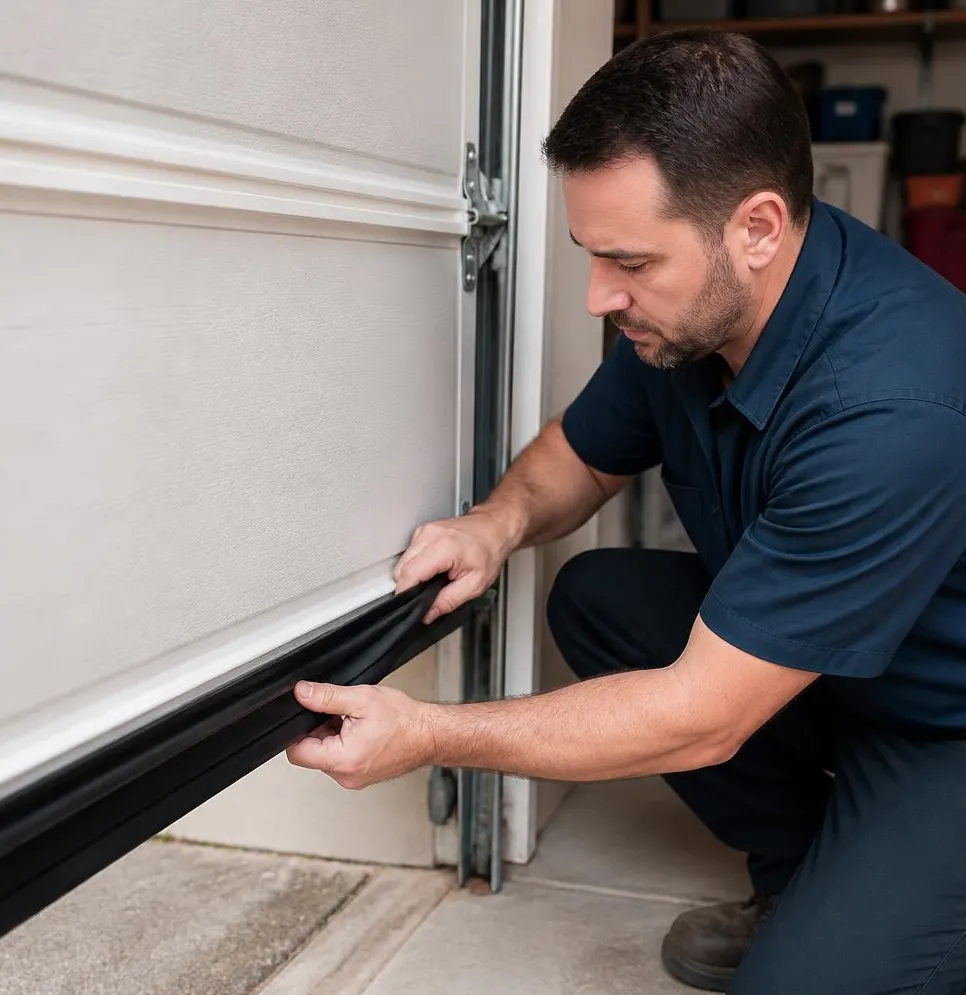
What a technician actually sees on these calls
A typical call starts the same way: the homeowner says the app shows the door as "closed," but it's sitting wide open, or the opposite — the app won't connect at all after a storm knocked out power for a few hours. Sometimes it's a battery backup that was installed three years ago and never tested, now dead right when a tropical system rolls through. Sometimes it's photo-eye sensors that have drifted out of alignment because humidity swelled the door track or the wood trim around it, so the opener reverses for no obvious reason. None of this is really a "smart" problem — it's a basic hardware and maintenance problem wearing a smart-home label. That's the first thing to understand before you shop: the app is a convenience layer on top of a mechanical system, and the mechanical system still has to hold up to heat, moisture, and salt air near the coast.
What smart openers actually do, day to day
Strip away the marketing and most smart openers give you four real functions: remote open/close from a phone, activity alerts (door opened, left open, closed by someone else), scheduling (auto-close at a set time), and shared access codes for guests, cleaners, or contractors without handing out a physical remote. For a household that travels, has a rental unit, or just wants to confirm the door closed before bed without walking out to check, these are genuinely useful. Everything beyond that — built-in cameras, voice assistant chatter, elaborate automation routines — is nice-to-have at best and a battery drain at worst.
Features that matter here
- Battery backup. With hurricane-season outages a real possibility, a working battery backup means you can still get the car out (or in) during a power cut. Check that it's rated to hold a charge through repeated cycles, not just a single opening.
- Belt drive over chain drive, where ceiling space allows. Belt drives run quieter and have fewer exposed metal parts prone to rust in salty, humid air. Chain drives are cheaper and fine for detached garages or less humid conditions, but near the coast the extra corrosion resistance of a belt is worth the price difference.
- Rolling code / encrypted signal. Any opener sold today should use rolling codes so a stored signal can't be replayed to open your door. Confirm it, don't assume it, especially on older stock.
- Adjustable force and travel limits. This matters more than people expect in this climate — doors swell slightly with humidity and need the force/limit settings rechecked seasonally so the opener isn't straining against a tighter-fitting door, which burns out motors early.
- Manual release you actually know how to use. During an outage, you need to disengage the opener and lift the door by hand. Know where the release cord is and test it once when the power is on, not for the first time during a storm.
- Weather-rated external sensors and keypads. If you're adding an outdoor keypad, make sure it's rated for direct sun and rain exposure — afternoon downpours are routine here, not occasional.
Features to ignore or deprioritize
- Built-in low-resolution cameras marketed as a security feature — a dedicated camera system will almost always do it better.
- Deep smart-home ecosystem lock-in (requiring one specific hub brand) if you don't already use that ecosystem — you're paying for compatibility you won't use.
- Multiple motor speed settings as a headline feature — nice, but rarely the deciding factor in daily use.
- Extremely long warranties on the motor only, with no mention of the circuit board or sensors, which fail more often in humid conditions than the motor itself.
Questions to ask before you buy or install
- Does the battery backup get tested automatically, or do I have to remember to check it myself?
- What's the actual horsepower/force rating, and is it enough for my door's weight and size — especially if it's a heavier insulated or impact-rated door?
- Can the opener be set up to meet wind-load requirements if I ever upgrade to a wind-rated door?
- How is the opener's circuit board protected from humidity — is it sealed, and is that sealing something that can be serviced if it fails?
- What's the manufacturer's warranty on sensors and the logic board specifically, not just the motor?
When to call Osprey Garage Door Service
If you're shopping for a new opener, replacing one that's constantly losing Wi-Fi, or you've never actually tested your battery backup, that's a good time to have us take a look. Our Garage Door Opener Installation service includes matching the motor and force settings to your actual door weight and travel distance — something box-store self-installs routinely get wrong, which shows up later as grinding, reversing, or early motor failure. And if your current opener is fine but the door itself feels sluggish, noisy, or slightly off-track after a season of storms and humidity, our Garage Door Maintenance & Tune-Up covers sensor alignment, lubrication, and force adjustments so the smart features actually work the way they're supposed to instead of fighting a door that needs attention.
If any of this sounds familiar, give Osprey Garage Door Service a call — we serve Osprey, Nokomis, Venice, Sarasota, Siesta Key, Englewood, North Port, and Laurel, and we'll give you a straight answer about what your door and opener actually need before storm season tests them for you.